
Understanding the difference between affect and effect is an important part of learning English grammar. These two words look and sound similar, so many people get confused about when to use each one. Even experienced writers sometimes make mistakes when choosing between affect and effect. The good news is that you can learn the difference by remembering a simple grammar rule.
In most everyday situations, affect is a verb that means to influence or change something, while effect is a noun that means a result or outcome. For example, you can say, “Lack of sleep can affect your mood.” In this sentence, affect describes how something influences your mood. On the other hand, “Lack of sleep can have a negative effect on your mood” uses effect to describe the result of not getting enough sleep.
Learning the affect vs effect difference can help you write clearer sentences, avoid common grammar mistakes, and communicate more confidently. These words are frequently used in school assignments, business writing, everyday conversations, and professional documents. Understanding their meanings will make it easier to choose the correct word in different situations.
In this article, we will explain the meaning of affect and effect in simple English. You will learn their grammar rules, see plenty of practical examples, and discover easy ways to remember the difference. We will also cover common mistakes and provide practice exercises with answers to help you improve your English grammar skills.
What Is the Difference Between Affect and Effect?
The main difference between affect and effect is their role in a sentence. In most everyday uses, affect is a verb that means to influence or change something, while effect is a noun that means a result or outcome. Although the two words look similar, they perform different jobs in English grammar.
For example, consider these two sentences:
- Lack of sleep can affect your concentration.
- Lack of sleep can have a negative effect on your concentration.
In the first sentence, affect describes an action: sleep deprivation influences concentration. In the second sentence, effect names the result of that influence.
Understanding this basic difference will help you choose the correct word when writing sentences, emails, school assignments, or articles.
Meaning of Affect
The word affect is usually used as a verb. It means to influence, change, or have an impact on someone or something. When one thing affects another, it causes a change or influences how something happens.
We use affect when talking about emotions, health, education, weather, work, relationships, and many other situations.
Examples of affect in sentences:
- Bad weather can affect our travel plans.
- Lack of sleep may affect your health.
- Stress can affect your ability to concentrate.
- The new rules will affect all students.
- Your attitude can affect your success.
- Noise can affect the quality of your sleep.
- Rising prices affect many families.
In these examples, affect describes how one thing influences another. For instance, bad weather may change travel plans, and stress may influence a person’s concentration.
Easy way to remember: Affect usually describes an action or influence.
Meaning of Effect
The word effect is usually used as a noun. It means a result, consequence, or change caused by an action or event. When something has an effect on you, it produces a particular result.
We often use effect when discussing the results of decisions, habits, treatments, weather conditions, or changes in everyday life.
Examples of effect in sentences:
- Exercise has a positive effect on health.
- The medicine had a strong effect on him.
- The new policy had an immediate effect.
- Lack of sleep can have a negative effect on memory.
- The rain had little effect on our plans.
- Her words had a lasting effect on me.
- The changes had a positive effect on the business.
In these sentences, effect refers to the outcome or result of something. For example, a positive effect on health means that something produces a beneficial result for a person’s health.
Easy way to remember: Effect usually names the result of an action or influence.
Affect vs Effect: Quick Comparison
The following table makes the difference between affect and effect easier to understand.
Here is another simple example:
- Affect: The teacher’s advice affected my confidence.
- Effect: The teacher’s advice had a positive effect on my confidence.
Both sentences describe a similar situation, but affect tells us about the influence, while effect identifies the result.
Remember that these are the usual rules, not absolute rules. Affect can also be a noun in psychology, and effect can be a verb meaning to bring about or accomplish something. However, in everyday English, remembering “affect = influence” and “effect = result” will help you choose the correct word in most situations.
you may also like it;
Descriptive Words for Creative Writing With Examples
English Synonyms and Antonyms List for Students
Advanced Vocabulary Words for Students With Examples
Common English Verbs With Examples for Beginners
Affect vs Effect Grammar Rules
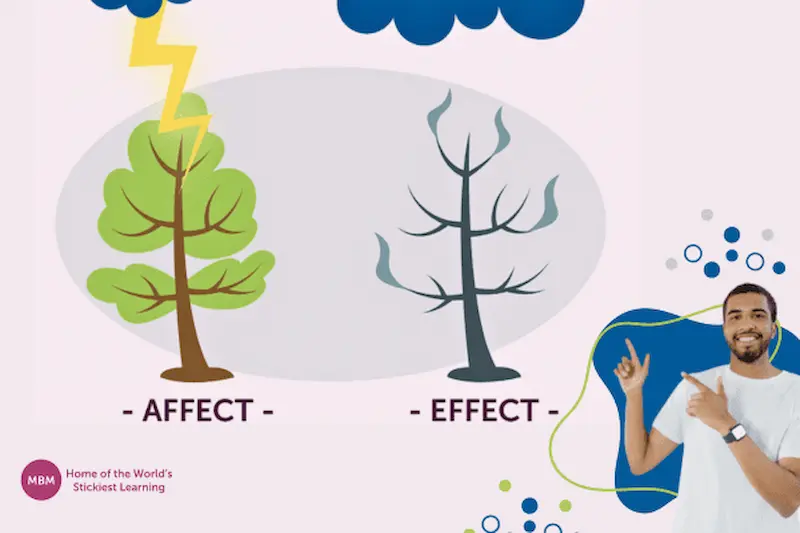
Learning the grammar rules for affect and effect will help you use these words correctly in everyday English. Although they have similar spellings and sounds, they usually serve different grammatical purposes. The easiest way to choose the right word is to identify whether you need a verb that describes an influence or a noun that names a result.
Let’s look at the main rules with simple explanations and examples.
When to Use Affect
Use affect when you want to describe how something influences, changes, or impacts a person, situation, or thing. In most everyday sentences, affect functions as a verb.
It often follows a subject that causes a change and comes before the object being influenced.
Sentence structure:
Subject + affect + object
Examples:
- Lack of sleep can affect your mood.
- The weather may affect our plans.
- Stress affects my concentration.
- The new schedule will affect all employees.
- Pollution can affect people’s health.
- Your decisions affect your future.
- The teacher’s feedback affected my confidence.
- Rising costs affect small businesses.
In these sentences, affect describes an influence. For example, stress can influence concentration, and weather conditions can change travel plans.
You can also use different forms of the verb, depending on the tense and subject.
Examples:
- The noise affects my sleep.
- The noise affected my sleep yesterday.
- The noise is affecting my sleep.
- The noise has affected my sleep.
The verb changes to match the sentence, but its basic meaning remains the same.
When to Use Effect
Use effect when you want to name the result, consequence, or outcome of an action or event. In everyday English, effect is most commonly used as a noun.
It often appears after words such as “a,” “an,” or “the,” and in phrases such as “have an effect on” and “the effects of.”
Sentence structure:
Subject + have/has/had + an effect on + object
Examples:
- Exercise has a positive effect on health.
- Stress can have an effect on your sleep.
- The medicine had an immediate effect.
- The new policy had a major effect on the company.
- Pollution has harmful effects on the environment.
- Her words had a lasting effect on me.
- The decision had little effect on our plans.
- The changes will have a positive effect on students.
In these examples, effect identifies the result or impact of something. For instance, the positive effect of exercise refers to the benefits it produces.
Affect as a Verb
A verb describes an action, process, or state. When you use affect as a verb, you explain how one thing influences another.
Examples of affect as a verb:
- The heat affects my energy level.
- The accident affected traffic for hours.
- Your habits can affect your health.
- The announcement will affect our schedule.
- Her support affected my decision.
- The economic changes are affecting local businesses.
- The results may affect the final decision.
Affect can appear in the present, past, or continuous tense. For example, “affects” is commonly used with he, she, it, and singular nouns in the simple present tense. “Affected” is used for the past tense, while “affecting” appears in continuous forms.
Remember that affect usually answers the question, “What is influencing or changing something?”
Effect as a Noun
A noun names a person, place, thing, idea, or result. When you use effect as a noun, you are talking about the outcome produced by an action, event, or condition.
Examples of effect as a noun:
- The new rules had a positive effect.
- The effects of stress can be serious.
- The medicine had no noticeable effect.
- The advertisement had a strong effect on customers.
- The storm caused significant effects across the region.
- Regular exercise can have beneficial effects. affect vs effect difference
- The decision had an unexpected effect on our plans.
Effect can be singular or plural. Use “effect” when referring to one result and “effects” when referring to multiple results.
For example, “The change had a positive effect” refers to one result, while “The changes had several positive effects” refers to more than one result. affect vs effect difference
An Important Exception to Remember
Although affect is usually a verb and effect is usually a noun, both words have less common uses.
Effect can be a verb meaning to bring about or accomplish something. For example, “The new manager hopes to effect meaningful changes.” Here, effect means to make changes happen. affect vs effect difference
Affect can be a noun in psychology, where it refers to the outward expression of emotion. For example, “The clinician observed the patient’s affect.” This is a specialized use rather than an everyday meaning.
For most everyday writing, however, you can follow the simple rule: use affect when you mean “influence,” and use effect when you mean “result.”
Affect vs Effect With Examples
The easiest way to understand the difference between affect and effect is to see how these words work in real sentences. Although they are often confused, each word has a different purpose in most everyday situations. Affect describes an action or influence, while effect names the result of that influence. affect vs effect difference
Let’s explore examples from daily life, including positive and negative sentences and questions.
Examples of Affect in Sentences
We usually use affect as a verb when describing how one thing influences or changes another. It is common in conversations about health, education, work, relationships, and everyday experiences.
Here are some simple examples:
- Lack of sleep can affect your memory.
- The weather may affect our travel plans.
- Stress affects my ability to concentrate.
- Your words can affect someone’s feelings.
- Exercise can affect your energy levels.
- The new rules will affect all students.
- Pollution affects the quality of the air.
- Rising prices affect many families. affect vs effect difference
- The teacher’s advice affected my decision.
- A positive attitude can affect your performance.
- The delay may affect our schedule.
- Noise is affecting my concentration. affect vs effect difference
- The changes have affected the entire team.
- Poor communication can affect relationships.
- Your daily habits affect your long-term health.
In each sentence, affect describes an influence or change. For example, lack of sleep can influence memory, and poor communication can change how people work together.
Examples of Effect in Sentences
We usually use effect as a noun when talking about the result or consequence of an action, decision, or event.
Here are some useful examples:
- Exercise has a positive effect on health.
- The medicine had a noticeable effect.
- Stress can have a negative effect on sleep.
- The new rules had an immediate effect. affect vs effect difference
- The teacher’s advice had a lasting effect on me.
- The weather had little effect on our plans.
- Pollution has harmful effects on the environment.
- The decision had an unexpected effect. affect vs effect difference
- Good communication can have a positive effect on teamwork.
- The advertisement had a strong effect on customers.
- Regular practice can have a beneficial effect on performance.
- The changes had several effects on the business.
- The news had a surprising effect on everyone. affect vs effect difference
- The delay had a negative effect on our schedule.
- Her kindness made a lasting effect on my life.
The last example is more naturally expressed as “Her kindness had a lasting effect on my life.” This is a useful reminder that the phrase “have an effect on” is often the clearest way to use effect as a noun. affect vs effect difference
Affect vs Effect Examples in Daily Life
Affect and effect appear in many everyday situations. Comparing the words in similar sentences makes the difference easier to remember.
Health and fitness:
- Affect: Drinking enough water can affect how you feel. affect vs effect difference
- Effect: Drinking enough water can have a positive effect on your well-being.
Education:
- Affect: Lack of preparation can affect your exam results. affect vs effect difference
- Effect: Lack of preparation can have a negative effect on your exam results.
Work and business:
- Affect: A new schedule may affect employees.
- Effect: A new schedule may have an effect on employee productivity.
Weather:
- Affect: Heavy rain can affect traffic. affect vs effect difference
- Effect: Heavy rain can have a major effect on traffic conditions.
Relationships:
- Affect: Harsh words can affect a friendship. affect vs effect difference
- Effect: Harsh words can have a lasting effect on a friendship.
These examples show that both words can describe the same general situation, but they perform different grammatical roles. Affect explains what influences something, while effect names the result.
Affect vs Effect in Negative Sentences
You can use both words in negative sentences. The word you choose depends on what you want to express.
Examples using affect:
- The noise does not affect my sleep.
- The weather did not affect our plans.
- This problem will not affect your final grade.
- The delay has not affected our work. affect vs effect difference
- His comments did not affect my confidence.
Examples using effect:
- The medicine had no effect on my headache.
- The changes had no noticeable effect.
- The new rules did not have a major effect on students.
- The treatment had little effect on the problem. affect vs effect difference
- The announcement had no lasting effect on the team.
Notice the difference: in the affect sentences, the word describes an influence. In the effect sentences, it names a result or outcome.
Affect vs Effect in Questions
Questions are another useful way to practice choosing the correct word. Use affect when asking whether something influences or changes another thing. Use effect when asking about a result. affect vs effect difference
Examples using affect:
- Does stress affect your sleep?
- Will the weather affect our trip?
- How does exercise affect your mood? affect vs effect difference
- Did the new policy affect your work?
- Can noise affect concentration?
Examples using effect:
- What effect does stress have on sleep?
- Did the medicine have any effect?
- What is the effect of exercise on your mood? affect vs effect difference
- What effect will the new policy have on your work?
- Does noise have an effect on concentration?
Remember the main rule when answering these questions: affect is usually a verb meaning “influence,” while effect is usually a noun meaning “result.” Practicing both forms will help you use them more naturally in everyday English. affect vs effect difference
How to Remember Affect vs Effect
Many English learners confuse affect and effect because the words look and sound similar. Fortunately, there are a few simple tricks you can use to remember which word belongs in a sentence. Once you understand these tricks, you will find it easier to choose the correct word in school assignments, emails, blog posts, and everyday conversations. affect vs effect difference
The Simple A-to-Z Memory Trick
One easy way to remember the difference is to connect each word with its most common meaning. affect vs effect difference
Affect = Action
Affect is usually a verb. It describes an action or influence that changes something. affect vs effect difference
For example:
- Lack of sleep can affect your mood.
- The weather affects our plans. affect vs effect difference
- Stress can affect your concentration.
In each example, affect describes how one thing influences another.
Effect = End Result
Effect is usually a noun. It refers to the result or outcome of an action, event, or situation.
For example:
- Lack of sleep can have an effect on your mood.
- The weather had an effect on our plans. affect vs effect difference
- Stress can have a negative effect on concentration.
In these sentences, effect identifies the result of the influence.
This memory trick works for most everyday uses of the two words. However, remember that effect can sometimes be a verb meaning “to bring about,” and affect can be a noun in psychology. affect vs effect difference
Easy Tips to Choose the Correct Word
If you are unsure whether to use affect or effect, follow these simple steps.
Think about the meaning of the sentence
Ask yourself what you want to say. Are you describing an influence, or are you naming a result?
- If you mean “influence,” use affect in most everyday sentences.
- If you mean “result,” use effect in most everyday sentences. affect vs effect difference
Check the grammar of the sentence
Affect commonly appears where an action verb is needed. Effect commonly appears after words such as “a,” “an,” “the,” or in phrases such as “have an effect on.” affect vs effect difference
For example:
- The decision may affect our future.
- The decision may have an effect on our future.
Both sentences are correct, but the grammatical roles of the words are different. affect vs effect difference
Try replacing the word
If you can replace the word with “influence” and the sentence still makes sense, affect is probably correct.
For example, “Noise can affect concentration” means “Noise can influence concentration.”
If you can replace the word with “result,” effect is probably correct. affect vs effect difference
For example, “The effect of the noise was distracting” refers to the result of the noise.
Learn common phrases
Some expressions make the correct choice easier to recognize.
Common phrases with affect:
- Affect someone’s mood
- Affect performance
- Affect the outcome
- Affect your health
- Affect a decision affect vs effect difference
Common phrases with effect:
- Have an effect on
- A positive effect
- A negative effect affect vs effect difference
- The effects of stress
- Side effects
Learning these common expressions will help you recognize the correct word more quickly.
Practice with your own sentences
Write a few sentences about school, work, health, or daily life. Try using affect in one sentence and effect in another.
For example:
- Too much screen time can affect your sleep.
- Too much screen time can have a negative effect on your sleep. affect vs effect difference
The more you practice, the easier it becomes to use these words correctly without stopping to think about the rules.
What is the main difference between affect and effect?
Affect is usually a verb meaning to influence or change something, while effect is usually a noun meaning a result or outcome. For example, “Stress can affect your sleep” and “Stress can have an effect on your sleep.”
When should I use affect in a sentence?
Use affect when you want to describe how something influences or changes a person, situation, or thing. For example, “Lack of sleep can affect your concentration.”
Is it correct to say “This will effect me”?
If you mean that something will influence you, the correct sentence is “This will affect me.” Effect as a verb is used in a different sense, meaning to bring about or accomplish something.
conclusion
Understanding the affect vs effect difference is an important step toward improving your English grammar and writing skills. Although these words look similar, they usually serve different purposes in a sentence. Affect is generally a verb that means to influence or change something, while effect is generally a noun that means a result or outcome. affect vs effect difference
For example, “Poor sleep can affect your mood” describes an influence, while “Poor sleep can have a negative effect on your mood” describes a result. Remembering this simple rule can help you avoid common mistakes in emails, school assignments, articles, and everyday conversations.
The best way to master these words is to practice using them in your own sentences. Pay attention to how affect and effect appear in books, articles, and other written materials. With regular practice, you will become more confident about choosing the correct word and expressing your ideas clearly.